Chain combat is the co-op rule in Chained Beasts
Chained Beasts is built for a party of one to four. Steam lists online co-op, shared or split screen, and Remote Play Together, and the same-screen note requires at least one gamepad. The store text says a coordinated chain can trip enemies, while a split party can wrap that chain around a pillar.
This page collects those store lines, what the official screenshots show, and a few observations from a GamesStarter review. It is a source compilation. The sentences below stay with the source they came from.
What the chain is for
The store heading is “Chained to Your Friends.” The paragraph under it says you gather four ferocious friends and get chained together in cruel and creative ways. If the group fails to coordinate, the page says you end up tangled around a pillar or worse. If the group synchronizes, it says you can trip enemies and turn the tables.
The short description pairs that with the arena itself: use the chains or the arena, win the crowd, and live with physical and mental injuries until the bosses fall. A launch note on the store page says to grab up to three friends, which matches a party of four.
The arena is part of the attack
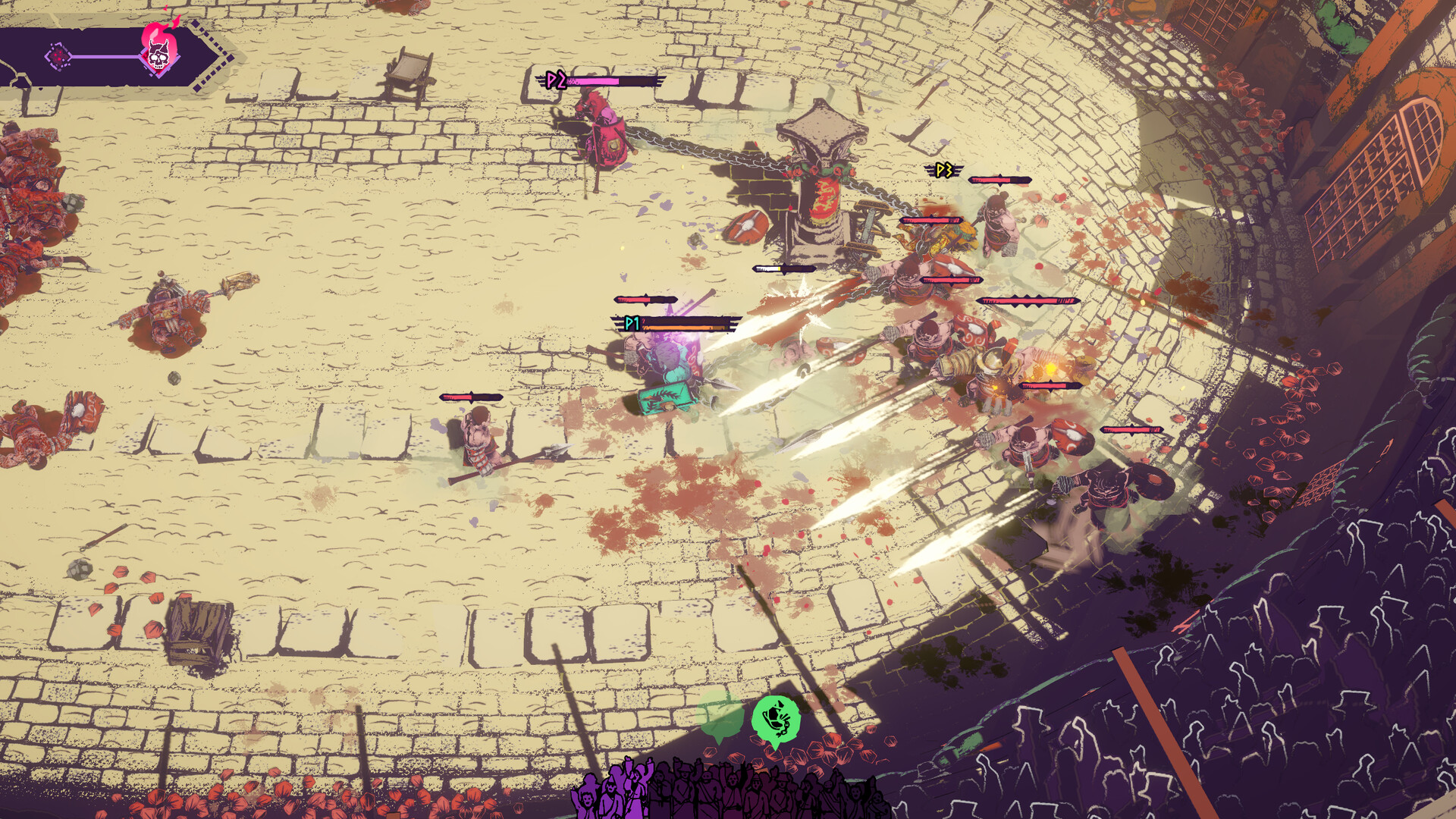
Under “Gladiatorial Combat,” the store page says you slash and hack, or you use the environment. The examples it prints are specific: hurl an urn at a foe or hurl a foe at an urn, charge someone into a wall of spikes or a pit of snakes, and throw weapons for a distant hit. The same paragraph says a thrown weapon leaves you in trouble if you have nothing else ready.
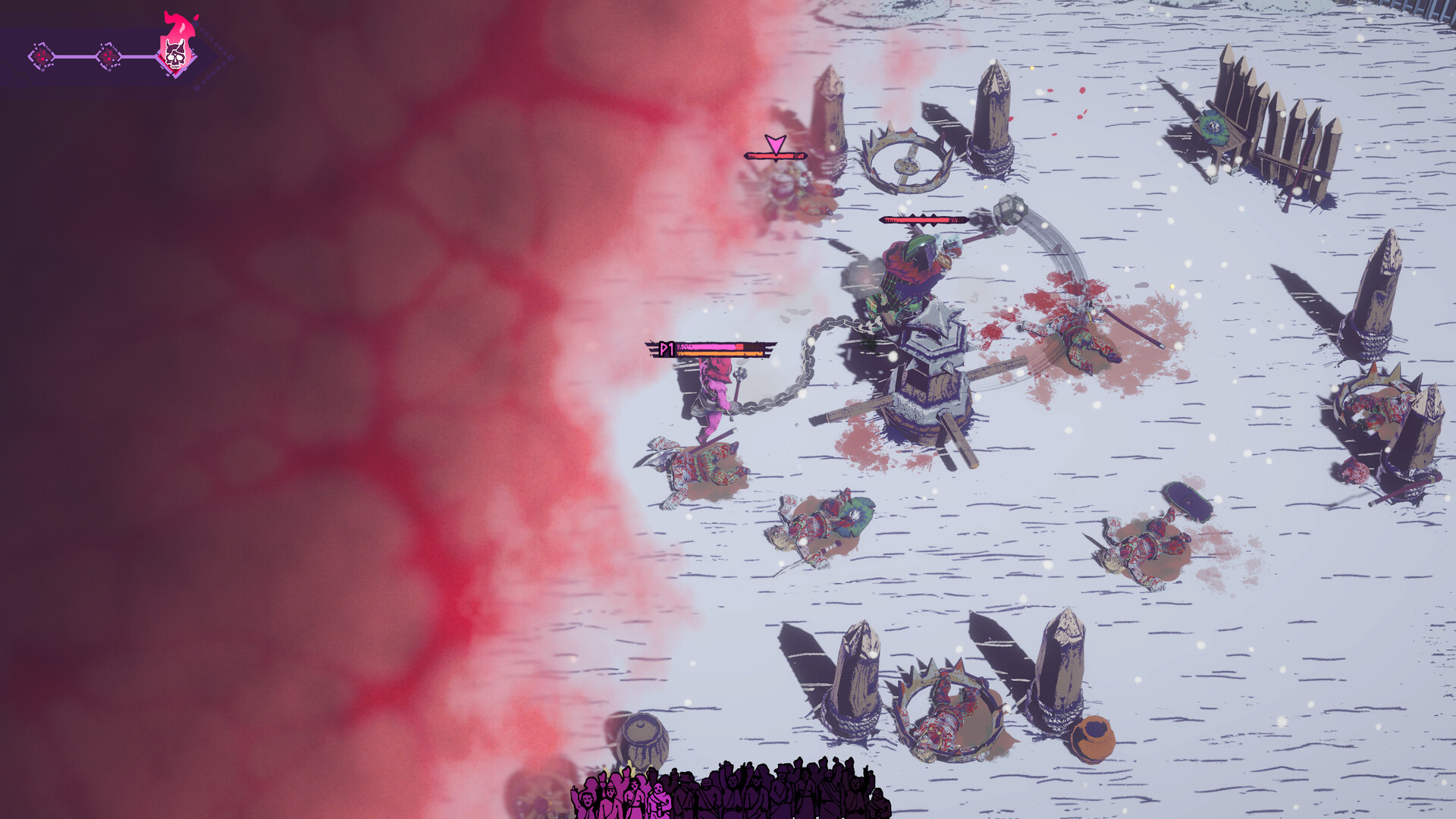
The screenshots add hazards the paragraph does not name one by one. A sand arena shows pillars and spiked bases. A snowfield shows burning stakes, bear traps, loose weapons, and an urn, with the chain still tying the fighters together. One side of that snow screenshot is covered by a heavy red haze. The store text mentions hallucinations only you can see, and this guide leaves the red haze as something the screenshot shows.
The crowd keeps score
The store page says that if you win the crowd, they will have your back. The screenshots show that line as a set of screens:
- Arena shots place a packed crowd along the bottom edge, sometimes tinted green or purple.
- The post-fight card grades Variety, Tempo, and Carnage. On the captured card, P3 is marked Crowd Favorite, and a reward total is printed below the four fighters.
- A Night I skill, On a Roll, says kills grant 4s of invulnerability if the crowd is going wild.
- A Night I affliction, On Fire I, says you sometimes catch fire when the crowd goes wild.
- A merchant passive, Pamphlets, says the crowd throws clubs to the crowd favorite.
Those last three are quoted on the afflictions page with the prices and the skill screen. The crowd is tied to damage, rewards, and at least one injury in the material Steam published.
Day fights, night choices
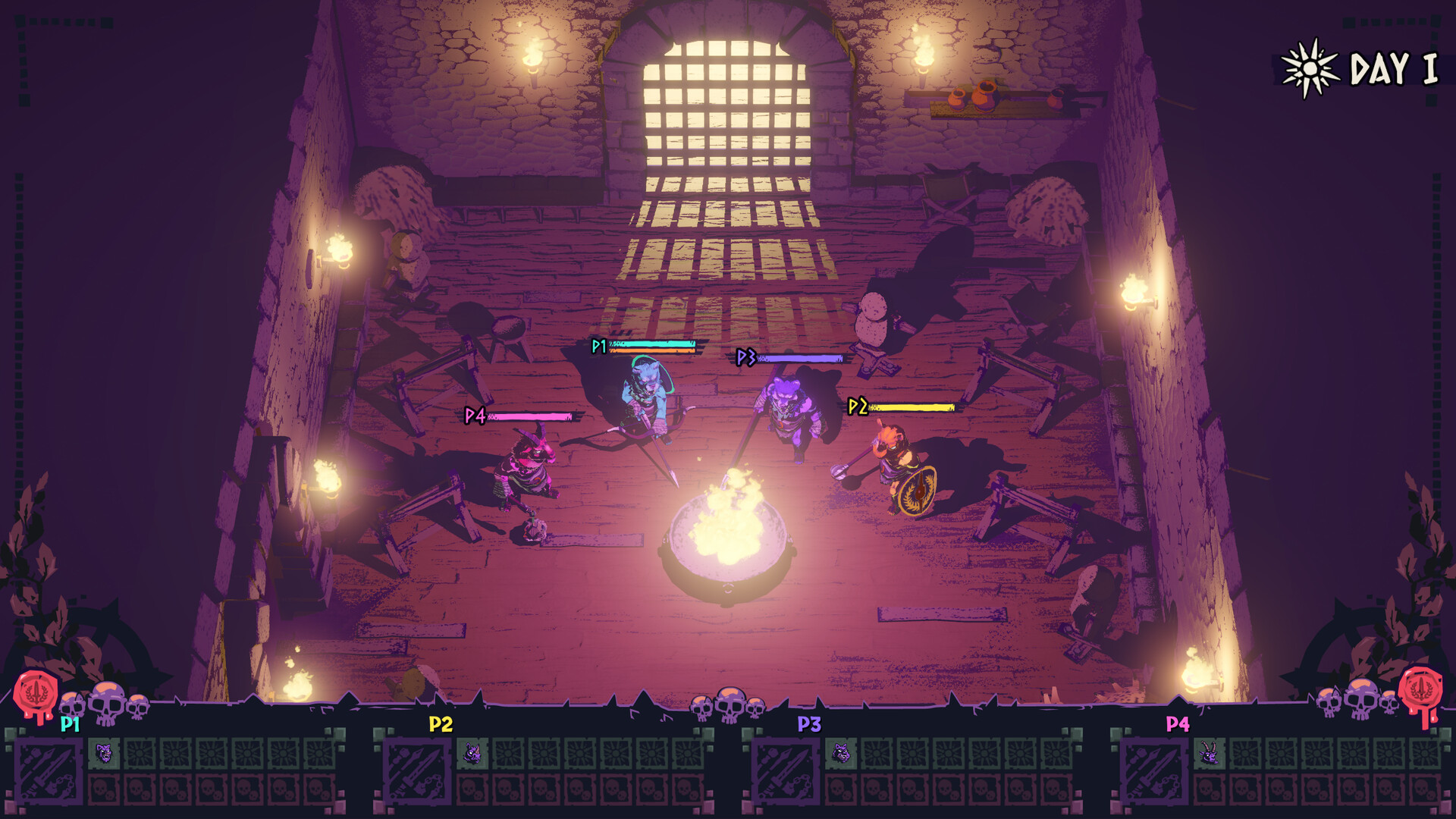
Three screenshots label the clock. A preparation room is marked Day I: four fighters, P1 through P4, stand around a brazier with weapon racks on the walls and an inventory grid for each player. A trainer screen and a skill screen are both marked Night I. The merchant is marked Night IV. The store page says each run takes a different path, that you learn skills, and that you spend money on equipment and weapons. The screenshots are the day-and-night shape of that loop. They do not print how many days a full run lasts.
Online, couch, and Remote Play
The captured feature row lists single-player, online co-op, shared or split screen co-op, shared or split screen, Cross-Platform Multiplayer, and Remote Play Together. Family Sharing, Steam Cloud, and Steam Achievements are on the same row.
Remote Play Together is Steam’s feature for inviting other Steam players into a shared session. The store lists it for this game. The same-screen additional note, repeated under Windows and macOS, says at least one gamepad is required for same-screen co-op. Controller flags are on the controls page.
Cross-Platform Multiplayer is also listed. The studio’s launch announcement names Steam, PlayStation 5, Nintendo Switch, and Game Pass on Xbox and Windows PC. A sentence that puts the console versions in the same match as Steam is absent from both the store page and the press release.
GamesStarter review
A GamesStarter review describes the chain as a simulated tether: trips need momentum and a real pull, the chain can wrap a pillar or clothesline a pack, and fighters can be swung into spikes or fire. The reviewer says creative chain tricks and environmental kills stir the crowd and pay back better drops and arena boosts. The review also says the game offers online matchmaking and local split-screen, and that a panicked sprint one way while a partner dodges the other way yanks both players out of position.
On solo play, the same review says the single-player game is the weaker half. Late fights, in that account, expect control in more than one direction, and the environmental chain tricks need more than one person hauling the chain. Steam’s own page still lists single-player, so both statements can sit together: solo is a listed mode, and the review finds it less like the game the chain was built for.
Compiled cautions
These follow the sources above. They are reading notes, compiled for this guide.
- Agree on a direction before someone sprints. The store text says poor coordination wraps the chain around a pillar, and the review describes the same yank when two players commit opposite ways.
- Keep a second weapon if you plan to throw the first. That warning is printed in the store’s combat paragraph.
- For a shared screen, bring a gamepad. That requirement is in Steam’s additional notes.
- Crowd favor shows up on the score screen and on at least one skill, one affliction, and one shop item. Playing only for a plain hit leaves those lines unused.